Thursday, 9 May 2013

The Mekong Delta


The ONLY way to see the Mekong Delta in its proper perspective is by small boat.  The Mekong River is some 5000km long reaching up into China, through Burma, Laos and Cambodia, but the important part of it, in a Vietnamese sense, is the first 100km or so.  The delta is vast, with hundreds of tributaries and canals, many of which are only several metres wide and others many kilometres wide and 40 to 50 metres deep.  The trip from Saigon to My Tho by bus, by itself is interesting but once you get on the canal and river system, the waterways are busy, crowded with hundreds of boats, mostly working, and thousands of homes and businesses perched on stilts on the side of the river, to avoid them flooding during the rainy season. The area is mostly rural and intensively farmed and there are areas where tourists rarely visit.

Keeping the canals clean is a major problem as ALL refuse is dumped into the water but many organisations are now working with the residents to educate them on environmental programs.  Reduced flows from dam-building up-river has also created many problems including reduction of fish numbers and disruption to breeding cycles, as well as increased salinity which could have a catastrophic effect on rice production.

Our boat tour consisted of only a dozen or so in the group, on a small boat with a captain and a tour guide – the best way to see the area.  The sight of waterside dwellings hanging over the canals, industry depending on the canals for transport and hundreds of ferries, small taxi-boats for river crossing and supermarkets on water, is a real eye-opener.  Most of the larger canals are regularly dredged to keep them from silting up and huge silt barges ply the waterways to keep them clear, the silt being used for building works on roads and levees.  Most of the boats use small diesel or petrol motors mounted on a swing-arm with a propeller attached, the arm used for steering as well as propulsion – very simple but very effective.  We spent about 7 hours travelling through the canals and waterways, including several stops to see some industries and markets along the way and a lunch break at a great little waterside restaurant.

We spent the over-night stop at Can Tho, a quite large city in one of the busiest ports along the river and loved the great street market there.  There are also several very highly regarded restaurants and the one we chose was extremely good – great food and a terrific atmosphere right on the river-front.   The following morning we set out for the huge floating market up-river from Can Tho and the experience was incredible – almost anything was available from fresh fruit and vegetables grown by small growers up and down the river, to meat, fish, crabs, poultry and other essentials available in the city market.  After our visit to the markets we bussed back to Saigon to spend a further day exploring this vibrant and exciting city.

Stilt homes along the canals
The local bus!
Strange pets in the Mekong

Bringing in the fresh produce

A barge-load of rice

Filling up the tank - a plastic jug!

Friendly kids along the canal

Taxi service

The huge suspension bridge over the Mekong at Can Tho

The floating market - many types of fresh produce

More of the floating market

Anyone for snake?

Duck's on the menu today

Floating fuel bowser - metal sides to prevent fire spreading.

You don't get fresher than this.

Simple propulsion - very effective

The local supermarket

Making sweet puffed rice

Cu Chi Tunnels

Boobytrap, covered with leaves,impossible to detect
Sharp stakes at bottom of trap to impale soldiers
Entrance to tunnel, covered with leaves, can't be seen
emerging from tunnel
Typical tunnel - less than 1 metre high
Larger work areas for cooking, bomb-making and sleeping
Entry from one level of tunnels to lower level
Making sandals from car or truck tyres
Princess ready to enter tunnel with head-lamp
Dining room
Representative dining-room to show larger tunnel area

Saigon or Ho Chi Minh City


Saigon is now officially known as Ho Chi Minh City, honouring the founder of modern unified Vietnam.  It is divided into 19 urban districts and is a city fast becoming a huge international centre for trade and commerce.  District 1, central or “Old Saigon” is a mix of old markets, traditional streets of small manufacturers, flash hotels and restaurants, alleyways and wide boulevards, tree-lined streets with cafes and shops and a busy night-club scene.  Notre Dame Cathedral, the Opera House, the Reunification Palace, Bitexco Financial Tower, the Majestic Hotel and Continental Hotel and Central Post Office are all features of this area, highlighting the changes wrought by progress of this modern, exciting city.  The Continental Hotel, for instance, was built in 1880 and was a favourite of the press corps during the French War and author Graham Greene regularly stayed in room 214 and the hotel featured in his book, “The Quiet American”.  The Bitexco Tower, a modern financial centre of 68 floors, features a “Skydeck” on the 49th floor which gives an amazing view over Saigon.
Some of the most significant memories we carried away were the Reunification Palace, the War Remnants Museum, the busy Ben Thanh Market, the Bitexco Tower and Skydeck and the open-air bar and restaurant on the top floor of the Rex Hotel where we enjoyed the fireworks over Saigon on the evening of the celebration day (April 30) – Independence Day – celebrating the reunification of North and South Vietnam in 1975.  We ate in some amazing restaurants and cafes, including Nha Hang Ngon, Lemon Grass and Huong Lai, Vietnam’s version of “15” where staff are from disadvantaged families, orphans or street-kids who receive on-the-job training, education and a place to stay and might I say, was one of the best experiences we had.
One morning we left on an excursion to the Cu Chi tunnels, only 30kms from Saigon, where up to 16,000 people hid from the Americans in the late 60s and early 70s, mostly farming families who’d been displaced by the war.  This was an area of enormous destruction, with intense fighting and bombing, but underground, a labyrinth of some 250km of tunnels were used to house families as well as the Viet Cong.  Constant harassment and surprise attacks on the Americans by the Viet Cong using the tunnels and hidden trap-doors eventually led to the Americans using their enormous fire-power to leave the district one of the “most devastated areas in the history of warfare”.  Two sections of the tunnels have been opened to tour groups (although somewhat enlarged from the original versions) and one wonders how people, even those as small as the Vietnamese, could live in such confined spaces for weeks and months at a time.


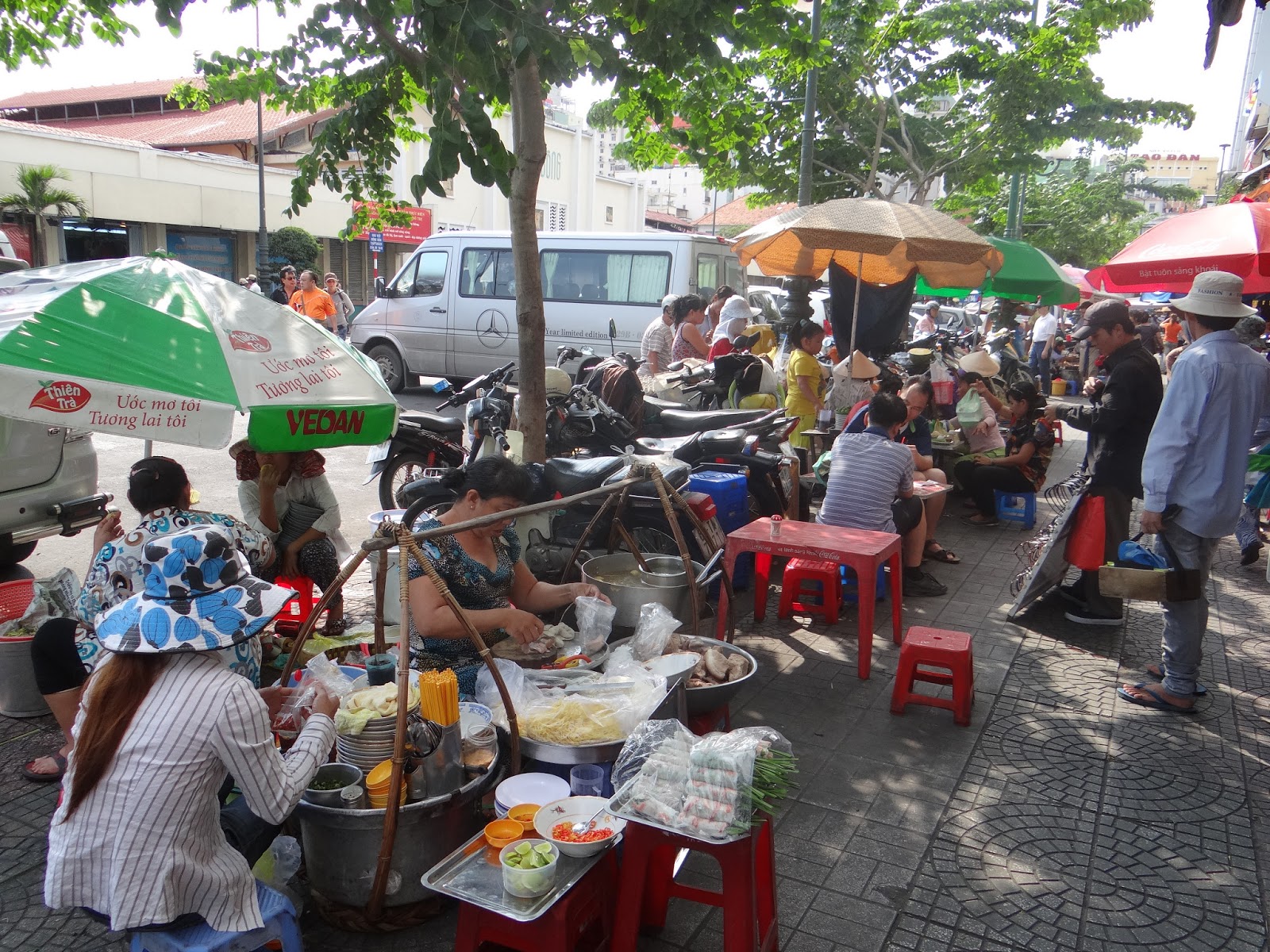
Street cafes - no permit required

Lots of motor  scooters, but wide boulevards

Garbage collection

Beautiful parks in the city

Ho Chi Minh statue

The Opera House

Hotel Continental - made famous by Graham Greene

Street market - very fresh food and amazingly, no odours

View of old Saigon from the Skydeck

Inside the Post Office - lovely old building

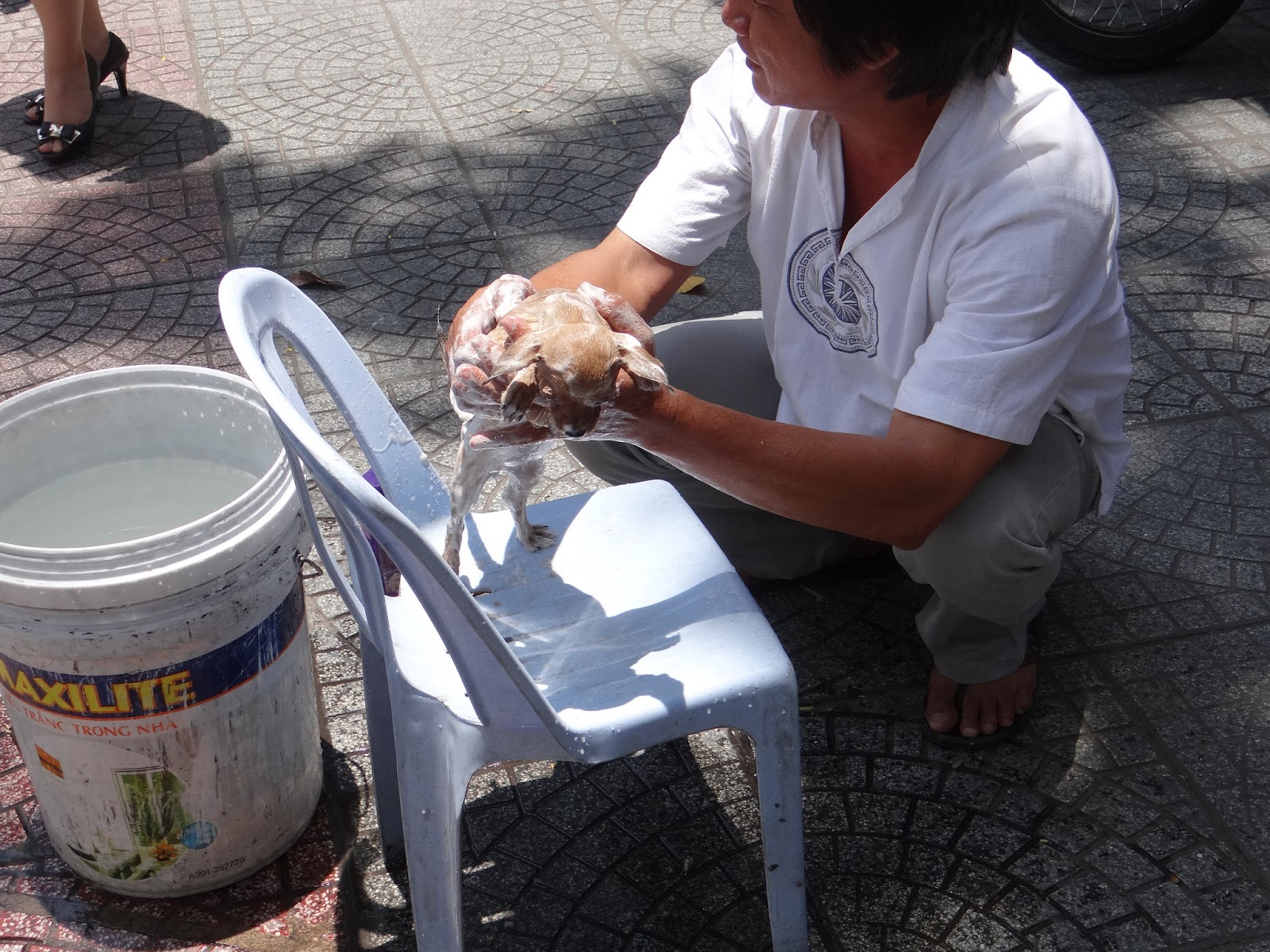
Washing the family dog

Mobile Patisserie

Reunification Palace

The centre of old Saigon - roundabout with market in foreground

Tuesday, 7 May 2013

Central Coast and Hoi An


The next leg of our Vietnam experience starts with a 1 hour flight from Hanoi to Da Nang, where the USA had an enormous base and airfield during the Vietnam war and where the famous “China Beach” is situated.  Thirty kilometres from Da Nang is the historic town of Hoi An, once a major trading port until the river silted up and it became a bit of a back-water, but one of the prettiest towns we encountered.  Today, Hoi An is a cosmopolitan melting pot, an important tourism centre, a culinary mecca and one of the nation’s most wealthy towns.  It contains beautiful old temples, Chinese and Japanese merchant houses, fantastic restaurants, boutique hotels and dozens of tailor shops.

Much of the Hoi An “old town” is preserved as it was a century or more ago, as UNESCO decreed that some 800 historical buildings be preserved.  Some of the best food we encountered whilst in Vietnam, was here in Hoi An.  The regional produce was fresh and clean, we ate at several of the restaurants and cafes we’d had recommended to us and were not once disappointed in any aspect of our experience.  Given the opportunity, this would be first place on our list to return to.  We stayed at the Vinh Hung Resort on the river-front (actually an estuary of the river) and there is a boat service from the hotel to the main town, about 10 minutes away, although it is only a few hundred metres away by foot.  The shopping in the old town, is fantastic.  We finished up having multiple items personally tailored, including jackets, pants, shirts, dresses and shorts, at a fraction of the cost of buying off-the-rack here.

  Also in the town are several cooking schools, as the people are very proud of their cuisine, so we decided that we’d like to gain a little knowledge and experience of Vietnamese cooking.  We’d heard of the “Red Bridge” school so we booked into that and it was a great experience.  The head chef was quite a character with a really wry sense of humour and a great style, who showed us how to make rice-paper, rice-paper rolls, fried pancakes with prawns and a great clay-pot dish.  We each had our own cooking station and had a really great time preparing each of the dishes (some more successful than others) and then they sat us down for a 4 course lunch as well.  A fantastic experience.
Pedestrian bridge across the river - no cars allowed in much of Hoi An
Japanese bridge between the old town and the Japanese quarter
Beautiful Hoi An
Typical bar/cafe - note the advertising
Drying fresh noodles in the sun
Residential street in the old town
Vinh Huhn Resort - great spot
Fresh fruit in the market
Fresh vegetables, some we've not seen before
Fresh meat (& fish) - amazingly there is no odour
Freshly made noodles
The crowded market
Master-Chef
Fresh rice-paper rolls and a proud "chef"
Hard at it over a hot stove
One of the local ferries